If you’ve ever left a physical therapy session with tiny needles and quietly thought, wait — was that just acupuncture? — you’re not the first person to wonder.
Dry needling has exploded in popularity over the last decade. Physical therapists, chiropractors, and athletic trainers now offer it for muscle pain, tightness, and injury recovery. And patients are often surprised to learn that the needle being used is identical — physically identical — to the one used in acupuncture.
So what exactly is going on here? Are dry needling and acupuncture the same thing? And if they’re not, does it really matter who’s on the other end of the needle?
After five years of graduate training in Traditional Chinese Medicine and years of practice here in Houston’s Meyerland area, I have some thoughts. Not to throw anyone under the bus — I know and genuinely respect physical therapists and chiropractors who are gifted clinicians. But I also believe that patients deserve honest information before they decide who they’re going to trust with a needle.
Let’s talk about it.
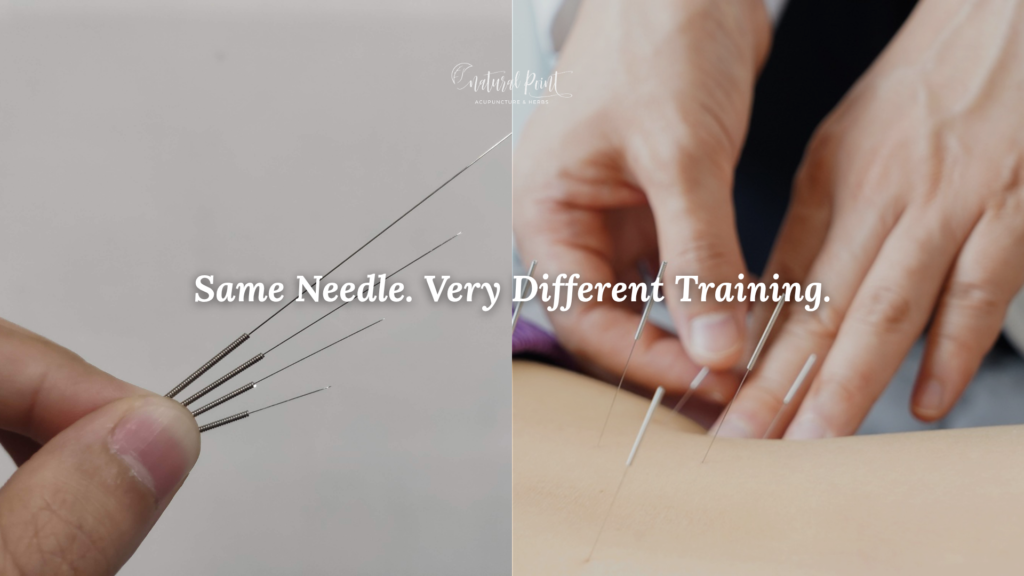
Same Needle. Two Very Different Stories.
Dry needling is a technique used by physical therapists, chiropractors, and some athletic trainers to treat muscular pain. The idea is to insert a thin filiform needle into what’s called a “trigger point” — a tight, tender knot in the muscle — to release tension and reduce pain. “Dry” simply means no injection is involved. It’s the needle itself doing the work.
Here’s what surprises most people: in Traditional Chinese Medicine, we have a concept called Ashi points. These are tender, reactive spots on the body that correspond to areas of local dysfunction. Ashi roughly translates to “that’s it” — as in, you press the point and the patient says, yes, right there. These have been documented in Chinese medical texts for over 2,000 years.
In 1942, a Western physician named Dr. Janet Travell began mapping what she called “myofascial trigger points” in modern medical literature. Decades later, when researchers compared her trigger point locations against classical acupuncture points, they found a 92% anatomical overlap. Dr. Travell herself documented this in her landmark 1983 textbook. If you want to go deep on this history, this resource puts together the full timeline — including how that 92% correspondence finding was later quietly de-emphasized in subsequent editions edited by physical therapists.
The short version: dry needling and acupuncture share the same needles, the same anatomical points, and thousands of years of the same underlying framework. The biggest difference isn’t the technique. It’s the training.
Let’s Talk About the Training Gap
This is the part that matters most for patients, so I’m going to be direct.
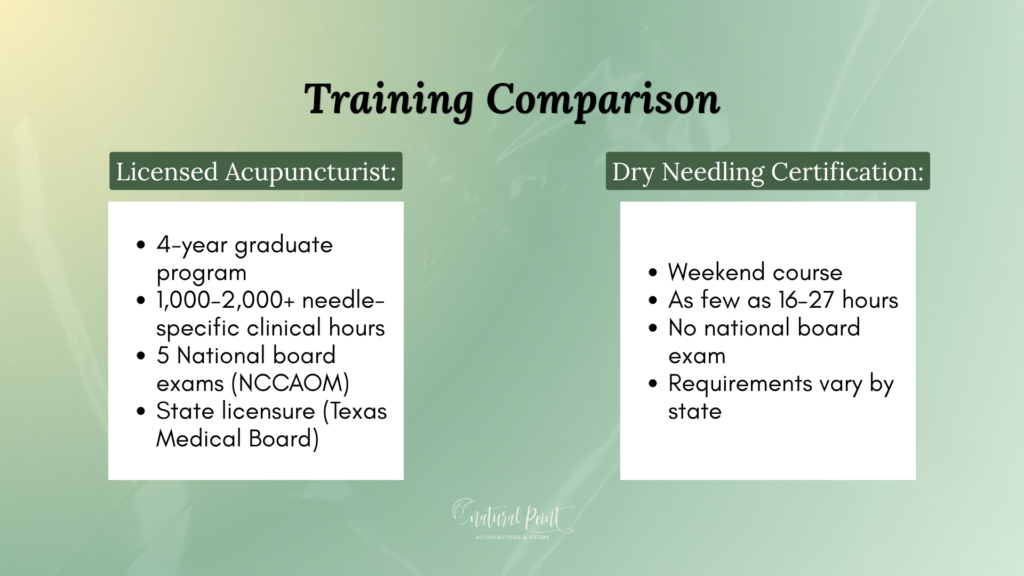
To become a Licensed Acupuncturist, I completed a Master’s degree in Oriental Medicine — five years of graduate education, including over 1,000 hours of supervised clinical needling, point location study across all 361+ classical acupuncture points, dedicated coursework on needle-safe tissue depths, anatomy, and adverse event management. Before I ever saw a patient on my own, I passed national board examinations through the NCCAOM and was credentialed by the Texas Medical Board.
The legal minimum to offer dry needling in many states? A weekend certification — sometimes as few as 16 to 27 hours of training.
To put that in perspective: I completed more supervised needling hours in my first year of clinical training than many dry needling certifications require in total.
To be fair — not every practitioner offering dry needling has only a weekend course. Some pursue significantly more training, and their clinical outcomes may reflect that. But what patients often don’t realize is that the baseline — the legal floor — is almost incomparable to what’s required to hold an acupuncture license. And most patients never think to ask.
What About Safety?
Here’s something that tends to surprise people: the most common reasons licensed acupuncturists face malpractice claims are heat lamp burns and cupping marks left on the skin too long. Pneumothorax — accidentally puncturing a lung — is essentially absent from acupuncture’s adverse event data.
That isn’t true across the board for dry needling. There have been documented cases, including among Olympic-level athletes, where needling performed by a physical therapist or chiropractor resulted in a punctured lung. Because these cases are reported as “dry needling injuries” rather than “acupuncture injuries,” they often don’t register in the public conversation about needling safety.
I want to be clear: serious adverse events from any needling are rare. This isn’t meant to scare you. But when a needle goes near your chest, your neck, or your upper back, the margin for error is real — and the training required to navigate those areas safely is not trivial.
Questions Worth Asking Before Anyone Needles You
Whether you’re seeing a licensed acupuncturist, a physical therapist, or anyone in between — you’re allowed to ask questions. Here are four good ones:
Are you a licensed acupuncturist, or is this a dry needling certification? Licensure requires graduate education, thousands of clinical hours, and passing national board exams. A dry needling certification does not.
How many hours of needle-specific training have you completed? There is a meaningful difference between 1,500 hours and 27. The answer to this question tells you a lot.
How often do you perform needling in your practice? Clinical competency is built through volume and repetition over time. A practitioner who needles a few times a week after a weekend course isn’t accumulating the same clinical depth as someone who works with needles daily.
What would you do if something went wrong? A licensed acupuncturist is trained specifically in adverse event recognition and management for needling therapy. This should be a comfortable question to answer.nds quickly at first, then shifts into deeper layers of regulation.
After Years of Practice, Here’s Where I’ve Landed
I love acupuncture. It changed my life before I ever became a practitioner — debilitating migraines, painful periods, joint pain, and insomnia that Western medicine had no real answers for. Acupuncture and Chinese herbal medicine gave me my life back, and that’s ultimately what sent me to school.
And after years of working with patients at my practice here in Meyerland, I’ve come to a pretty clear conclusion: acupuncture is genuinely powerful medicine — especially for pain. Musculoskeletal issues, tension headaches, nerve pain, injury recovery — acupuncture shines in these areas. If pain is your main concern, it’s absolutely still part of how I work with patients.
But for everything beyond pain — the hormonal imbalances, the digestive issues, the fatigue that just won’t lift, the brain fog and dampness that accumulates over time, the anxiety that wakes you up at 3am — I’ve found that Chinese herbal medicine is more effective as the primary treatment. Acupuncture supports the work. Herbs do the deep, sustained healing.
This is actually why I’ve been restructuring my practice around herbal medicine as the primary treatment modality. It’s not a departure from Chinese medicine. It’s a deeper commitment to what actually works across a full range of health concerns.
If you’ve been wondering whether acupuncture and herbal medicine could be the missing piece for what you’re dealing with — that’s exactly the kind of conversation I love having. Learn more about how I approach treatment at Natural Point Acupuncture.
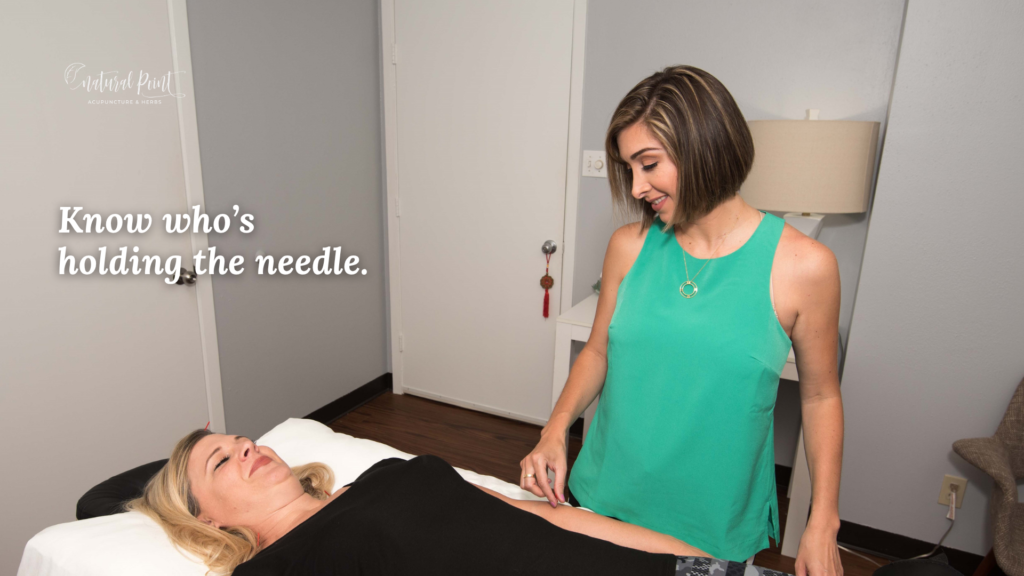
Curious About What’s Actually Right for You?
Whether you’ve had dry needling before and want to understand the difference, you’re dealing with pain and want to explore acupuncture, or you’re wondering whether herbs might be the better fit for your situation — I’d love to talk it through.
Book a free 15-minute consultation here and let’s figure out together what your body actually needs.
Or if you’re ready to get started, book your first appointment at Natural Point Acupuncture.
And if pain is bringing you here — grab my free guide on 5-minute acupressure points for pain relief that you can use at home right now.