I get asked this question almost daily: “Are Chinese herbs safe?”
It’s a fair question. You’ve probably seen the headlines about contaminated supplements, heard stories about dangerous ingredients, or felt overwhelmed by conflicting information online. With Chinese herbs available everywhere from Amazon to Houston’s Asian markets to Instagram ads, it’s hard to know what’s legitimate and what’s risky.
I’m Jenny Vargas, a Licensed Acupuncturist and Board-Certified Herbalist here in Houston’s Meyerland area. I’ve been prescribing Chinese herbs for years, and I take them myself. But here’s the reality: not all Chinese herbs are created equal.
The short answer to “are Chinese herbs safe” is: yes, when done right.
The difference between safe, effective herbs and contaminated, dangerous ones comes down to three critical factors:
- Quality sourcing with proper testing
- Professional prescription by qualified herbalists
- Ongoing monitoring throughout treatment
Let me answer your questions honestly – including the uncomfortable truths about online herbs, contamination risks, and why professional guidance matters more than you might think.
THE SAFETY ANSWER YOU’RE LOOKING FOR
Chinese herbs ARE safe when:
- Sourced from GMP-certified suppliers who test every batch
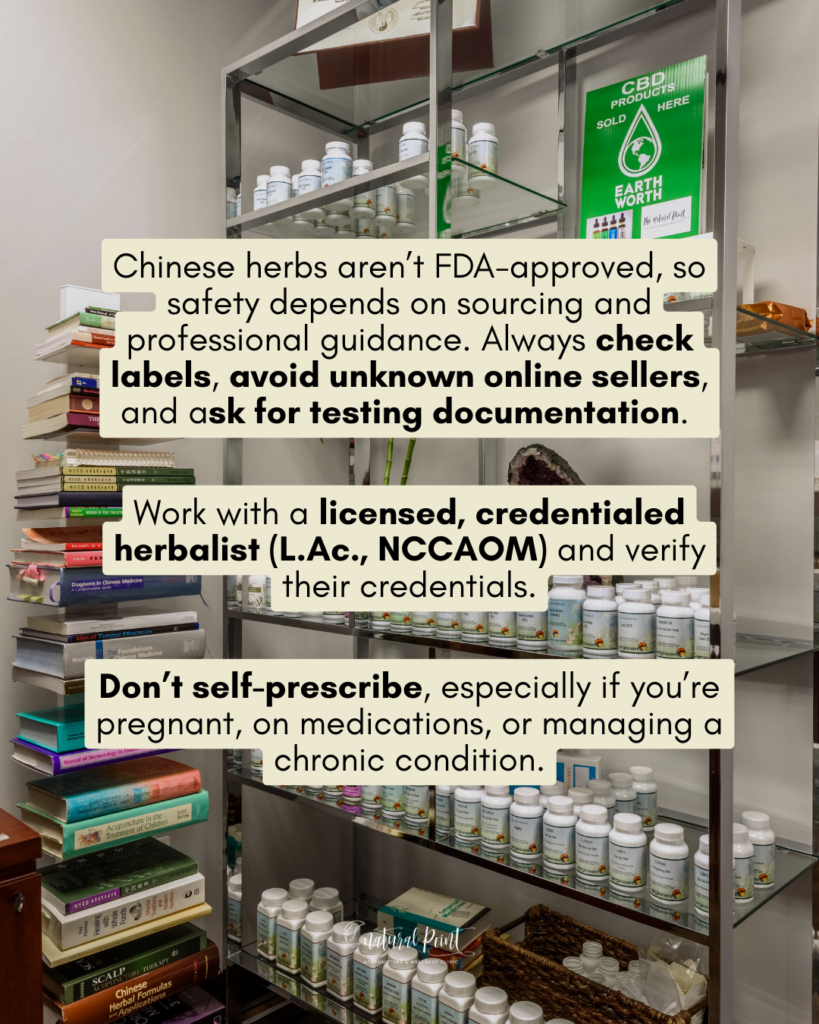
- Prescribed by qualified herbalists (Licensed Acupuncturists with NCCAOM certification)
- Customized to your specific health pattern, not generic “one-size-fits-all” formulas
- Monitored throughout treatment with formula adjustments
- Free from heavy metals, pesticides, and microbial contamination
Chinese herbs are RISKY when:
- Bought from unknown Amazon sellers or random websites
- Self-prescribed without understanding TCM diagnosis
- Sourced from suppliers who don’t test products
- Taken alongside medications without professional review
- Used at inappropriate doses or for wrong conditions
The real question isn’t “are Chinese herbs safe in general” – it’s “are THESE specific herbs, from THIS source, prescribed by THIS practitioner, safe for ME?”
Think of it this way: Prescription medications are safe when prescribed by doctors and filled by licensed pharmacies following FDA regulations. But buying prescription drugs from a sketchy website? Dangerous. The same principle applies to Chinese herbs.
The safety issue isn’t about Chinese medicine being inherently dangerous. It’s about:
- Quality control (or lack of it)
- Proper sourcing (reputable vs. questionable suppliers)
- Professional expertise (qualified herbalists vs. self-prescribing from Google)
By the end of this article, you’ll know exactly what to look for to ensure you’re getting safe, effective Chinese herbal medicine in Houston – and what red flags to avoid.
HOW I ENSURE HERBAL SAFETY IN MY PRACTICE
Let me be completely transparent about how I source and prescribe herbs at Natural Point Acupuncture. This is the standard you should expect from ANY herbalist.
My Supplier: Evergreen Herbs
I exclusively use Evergreen Herbs, a professional-grade supplier that sells only to licensed practitioners. Here’s why I trust them:
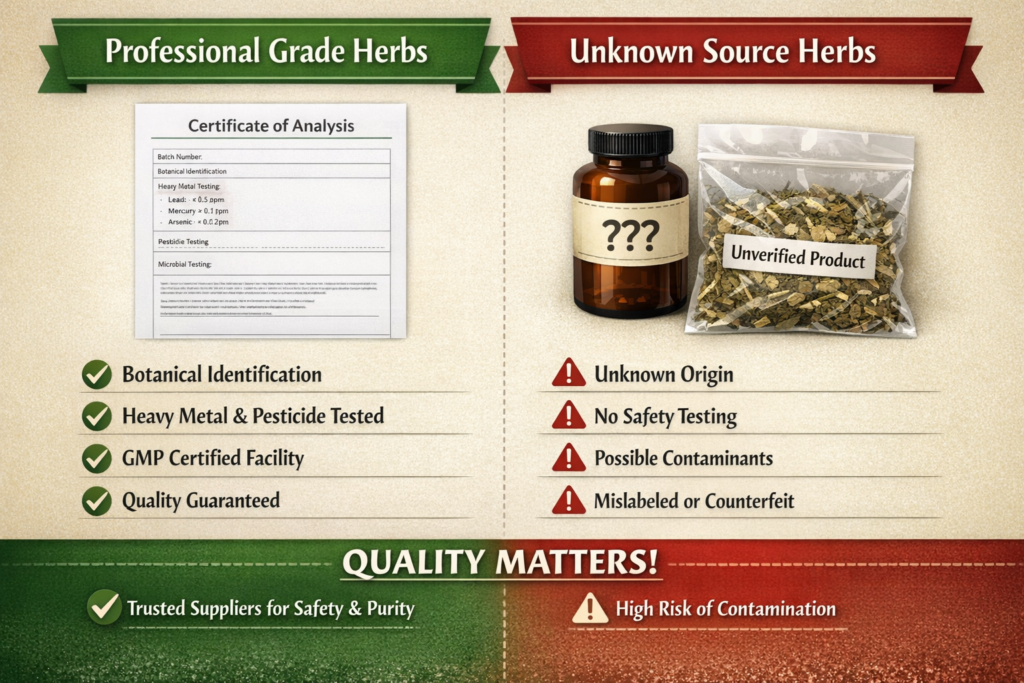
GMP Certification & Testing Every batch undergoes testing for:
- Heavy metals (lead, mercury, arsenic, cadmium)
- Pesticides and agricultural chemicals
- Microbes (bacteria, mold, yeast)
- Herb authenticity (ensuring you get the actual plant, not substitutes)
- Potency (active compounds at therapeutic levels)
Certificates of Analysis (COA) For any herb I dispense, I can show you the Certificate of Analysis proving it passed safety testing. This isn’t marketing fluff – this is documentation.
Professional-Grade Access Evergreen requires practitioner credentials to purchase. This creates accountability – they’re selling to trained professionals who know how to use herbs safely, not to random consumers.
My Prescribing Process
Step 1: Complete TCM Diagnosis (45-60 minutes) I don’t prescribe based on symptoms alone. I perform full Traditional Chinese Medicine diagnosis including:
- Complete health history and current medications
- Tongue diagnosis (shows internal patterns)
- Pulse diagnosis (reveals organ system imbalances)
- Pattern differentiation (identifying YOUR specific TCM pattern)
Step 2: Custom Formula Creation Based on your unique pattern, I create a customized formula – not a generic product off the shelf.
Step 3: Medication Interaction Check Before prescribing anything, I review all medications, supplements, and herbs you’re taking. Some herbs interact with blood thinners, diabetes medications, antidepressants, and more. A qualified herbalist knows these interactions.
Step 4: Clear Instructions & Monitoring You receive written dosing instructions, storage guidelines, what to expect, and when to call me. We check in regularly (weeks 2-3, then 4-6, then ongoing) to monitor effectiveness and adjust formulas as your body changes.
This isn’t “take these and good luck.” This is active medical care.
Cost Reality
Custom herbal formulas at my practice typically cost $35-55 for a month’s supply. Yes, you can use HSA/FSA accounts for herbs prescribed by licensed practitioners.
Is this more expensive than Amazon? Yes. But quality testing, professional diagnosis, and ongoing monitoring aren’t free – and they’re what keep you safe.
THE CONTAMINATION PROBLEM: WHY SOURCING MATTERS
Let’s talk about the elephant in the room: heavy metal contamination and why not all Chinese herbs are safe.
The Real Contamination Cases
This isn’t theoretical. Real contamination cases have happened:
The Aristolochic Acid Scandal In the 1990s-2000s, some Chinese herb products were contaminated with aristolochic acid (from the wrong plant species), causing kidney damage in patients. This happened because manufacturers substituted cheaper plants or misidentified species.
Professional suppliers like Evergreen test for botanical authenticity specifically to prevent this.
The PC-SPES Case A popular “natural” prostate supplement called PC-SPES was found to contain pharmaceutical drugs (DES, warfarin, indomethacin) not listed on the label. It was eventually pulled from the market.
Ongoing Heavy Metal Findings Studies continue to find elevated lead, mercury, or arsenic in some Chinese herbal products – particularly those from unknown manufacturers or countries with less regulation.
Why This Happens
Heavy metal contamination typically comes from:
- Industrial pollution in soil and water where herbs are grown
- Poor agricultural practices
- Contaminated processing equipment
- Lack of testing by manufacturers
This is why professional suppliers matter. Companies like Evergreen source from clean agricultural regions, test every batch against strict standards (USP, California Prop 65, WHO guidelines), and reject any herbs exceeding safety limits.
How the FDA (Doesn’t) Regulate Herbs
In the U.S., Chinese herbs are classified as dietary supplements, not drugs. This means:
The FDA does NOT:
- Pre-approve herbs before they’re sold
- Test products for safety
- Verify label accuracy
- Monitor quality
The FDA ONLY intervenes AFTER problems are reported.
This regulatory gap means the burden falls on manufacturers and prescribers. High-quality suppliers like Evergreen voluntarily follow strict standards because they’re selling to licensed professionals who demand it.
Amazon sellers? No such accountability.
The Three-Tier Quality Reality
Tier 1: Professional-Grade (Evergreen, Kan Herbs, Blue Poppy)
- Sell ONLY to licensed practitioners
- Extensive testing and GMP certification
- Certificates of Analysis available
- Cost more, but safe
Tier 2: Consumer-Grade Health Food Stores
- Some reputable brands exist
- Quality varies widely
- Less rigorous than professional-grade
Tier 3: Unknown Online Sources
- Amazon third-party sellers, random websites
- NO testing verification
- This is where contamination risks live
- Often counterfeit or mislabeled
When I prescribe herbs, they’re Tier 1. Always.
REAL TALK: THE AMAZON & ONLINE HERB PROBLEM
I’m going to be direct about buying Chinese herbs from Amazon and random websites. This information might cost me some readers who want to keep buying cheap herbs online, but you deserve the truth.
Why Amazon Chinese Herbs Are Risky:
1. Zero Source Verification Most Amazon sellers won’t tell you:
- Where herbs were grown
- What testing was done (if any)
- Manufacturing facility details
- Quality control processes
You’re buying completely blind.
2. The Counterfeit Problem The herbal supplement market has a significant counterfeit issue. Products tested have been found to contain:
- Fillers instead of actual herbs
- Different plants than labeled
- Synthetic pharmaceutical drugs added (to make ineffective herbs seem to work)
- Contamination with heavy metals
3. Self-Prescribing Is Dangerous Even IF the herbs are legitimate and clean, Amazon can’t tell you:
- Whether this formula matches YOUR TCM pattern
- Appropriate dose for your specific situation
- How it interacts with your medications
- How long to take it or when to adjust
You’re essentially prescribing yourself powerful botanical medicine based on product reviews written by non-professionals.
4. Storage and Handling Issues Herbs sitting in Amazon warehouses (or third-party seller storage) in Houston’s heat and humidity? That degrades potency and can promote mold growth. Professional suppliers maintain climate-controlled storage.
5. No Accountability Chain If something goes wrong:
- Where’s the manufacturer?
- Can you trace the batch?
- Who do you contact?
- Is there any documentation?
With professional suppliers through licensed practitioners, there’s complete traceability.
“But It’s So Much Cheaper!”
Yes, Amazon herbs cost less. Here’s what you’re actually getting:
- No testing costs = unknown contaminants
- No professional diagnosis = wrong formula for your needs
- No monitoring = extended suffering if it doesn’t work
The Real Cost Calculation:
Many patients come to me after spending months (and $100-200) trying various Amazon herbs that didn’t work. Then they spend $150-200 on professional treatment (consultation + herbs) and their issue resolves in 6-8 weeks.
Total Amazon approach: $150 wasted + months of continued suffering
Professional approach: $150-200 + actual results
The “savings” disappear when you factor in wasted time and delayed treatment.
My Honest Recommendation:
Don’t buy Chinese herbs from Amazon or unknown online sellers. Period. The risks aren’t worth the minor cost savings. If cost is a concern, let’s talk about it during your consultation – I’d rather work with you on payment options than have you take potentially dangerous herbs.
WHAT ABOUT HOUSTON’S ASIAN MARKETS?
Houston has wonderful Asian markets – H-Mart, 99 Ranch, Hong Kong Market. I shop there for food ingredients regularly. But medicinal herbs? Here’s my honest assessment:
For Food-Grade Herbs: Asian markets are great for culinary herbs like ginger, goji berries, dried dates, and lotus seeds that you’re using in cooking or making tea occasionally. The risk is minimal with food amounts.
For Medicinal-Grade Formulas: The quality situation is complicated:
- Testing documentation usually unavailable
- Labeling often only in Chinese
- Storage conditions vary (Houston humidity affects herb quality)
- Staff typically aren’t trained herbalists
- No way to verify sourcing or authenticity
Some Asian markets carry reputable brands like Plum Flower or Min Shan, which are better than random products. But even these consumer-grade lines aren’t held to the same standards as professional-grade suppliers.
My Middle-Ground Recommendation:
If you’re knowledgeable enough to:
- Read Chinese labels accurately
- Understand TCM formulation
- Verify brand reputation
- Know appropriate dosing for your pattern
Then certain Asian market products might be acceptable for maintenance or mild concerns.
But for treating actual health conditions? Professional-grade herbs through a qualified herbalist are worth the investment.Houston-Specific Warning: Check herb storage at markets. Are bottles/packages in climate-controlled areas? Do they look fresh or covered in dust? Houston’s humidity makes proper storage even more critical. Herbs stored in humid conditions lose potency and can develop mold.
COMMON SIDE EFFECTS VS. SERIOUS REACTIONS
Let’s set realistic expectations about what to expect when taking Chinese herbs.
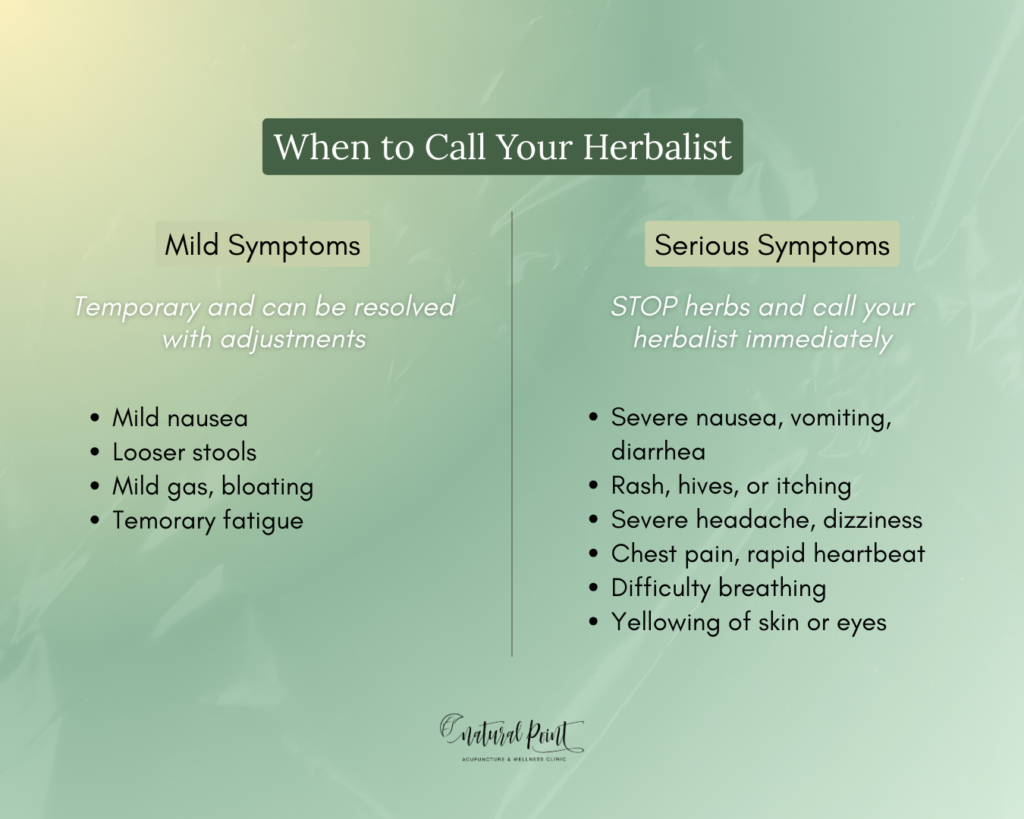
Normal, Temporary Side Effects
Digestive Changes:
- Mild nausea (usually if taking on empty stomach)
- Looser stools (herbs moving things through – often the goal)
- Mild gas or bloating (digestive system adjusting)
Solution: Take with food, reduce dose slightly, or call me to adjust the formula. These typically resolve within a few days.
Taste Issues: Herbs can taste bitter or earthy. Take with honey, in capsule form, or mix with a bit of juice.
Mild Detox Symptoms:
- Temporary fatigue
- Slight headache (rare)
- Increased urination (some herbs are diuretic)
Solution: Drink more water and rest.
Warning Signs – Call Me Immediately
Stop herbs and contact me if you experience:
- Severe nausea, vomiting, or diarrhea
- Rash, hives, or itching
- Severe headache or dizziness
- Chest pain or rapid heartbeat
- Difficulty breathing
- Yellowing of skin or eyes (jaundice)
- Dark urine or pale stools
These are extremely rare with properly prescribed, quality herbs – but know the warning signs.
The Safety Record
Chinese herbs have been used for over 2,000 years by billions of people. When properly prescribed using quality-controlled herbs, serious side effects are rare.
According to FDA’s adverse event database, prescription medications cause hundreds of thousands of hospitalizations annually. Chinese herbs? A tiny fraction – and most involve contaminated products or self-prescribed inappropriate use.
Special populations requiring extra caution:
- Pregnant women (some herbs contraindicated)
- Children (dosing adjustments needed)
- Elderly (more sensitive)
- Patients with liver/kidney disease
- Patients on multiple medications
These groups aren’t excluded – they just need extra monitoring.
WHAT CREDENTIALS SHOULD YOUR HERBALIST HAVE?
In Texas, anyone can call themselves an “herbalist” – there’s no state licensing requirement for the title. This means unqualified people can (and do) dispense herbs. Here’s how to protect yourself:
Essential Credentials to Look For:
1. Licensed Acupuncturist (L.Ac.) This is currently the ONLY state-regulated credential for Chinese herbal practitioners in Texas. Licensed Acupuncturists are credentialed by the Texas Medical Board after:
- Completing a Master’s degree in Oriental Medicine (3-4 years)
- Passing national board exams
- Meeting continuing education requirements
2. NCCAOM Certification The National Certification Commission for Acupuncture and Oriental Medicine credentials practitioners nationally. Look for:
- Dipl. O.M. (Diplomate of Oriental Medicine) – includes herbology
- Dipl. C.H. (Diplomate of Chinese Herbology) – herbs specifically
Verify credentials at NCCAOM.org
3. Master’s Degree (MAOM) Look for 3-4 year programs from accredited schools, which include:
- 2-3 years of herbal medicine study
- Supervised clinical training
- Western medical sciences (anatomy, physiology, pharmacology)
- Safety protocols and contraindications
Red Flags – Avoid Practitioners Who:
- Completed only weekend certification courses
- Have “online herbalist certificates” from non-accredited programs
- Aren’t licensed by any state board
- Can’t show credentials or license numbers
- Make unrealistic promises (“cure cancer naturally!”)
- Won’t discuss safety, interactions, or testing
- Pressure you to buy large quantities upfront
My Credentials (For Transparency):
- Licensed Acupuncturist (Texas Medical Board)
- NCCAOM Board Certified in Acupuncture and Chinese Herbology
- Master of Acupuncture & Oriental Medicine (MAOM) from American College of Acupuncture & Oriental Medicine (one of the top U.S. programs)
- Continuing education in herbal medicine (ongoing requirement)
You can verify my license through the Texas Medical Board.
Would you take prescription medication from someone who took a weekend pharmacy course? No. Apply the same standard to Chinese herbs.
WORKING WITH MEDICATIONS: THE INTEGRATION QUESTION
Can you take Chinese herbs with medications? Usually yes – BUT full disclosure to both practitioners is critical.
Why Communication Matters
Some herbs interact with medications by:
- Affecting drug metabolism
- Enhancing or reducing medication effects
- Influencing blood clotting, blood pressure, or blood sugar
This doesn’t mean you can’t take herbs – it means careful prescribing.
Common Interactions I Manage:
Blood Thinners (Warfarin, Aspirin): Some herbs affect clotting. I adjust formulas to avoid these herbs OR coordinate with your doctor for monitoring.
Diabetes Medications: Some herbs lower blood sugar. We monitor closely and medication doses may need adjustment.
Blood Pressure Medications: Formulas are adjusted to complement, not complicate, your treatment.
Thyroid Medications: Timing of doses matters for absorption.
The Right Integration Approach:
- Tell me EVERY medication (including over-the-counter)
- I research interactions before prescribing
- I provide documentation to share with your doctor
- We monitor your response
- Communication with your medical team (with your permission)
I’ve successfully treated countless patients who take medications and herbs together. The key is transparency and coordination.
Your doctor and I aren’t competing – we’re collaborating for your health. I respect conventional medicine and often work alongside it.
Read more about taking care of your mental health and how acupuncture supports digestive health – both areas where herbs and medications often work together.
CHINESE HERB SAFETY: FREQUENTLY ASKED QUESTIONS
Are Chinese herbs FDA-approved? (H3)
No, because the FDA regulates herbs as dietary supplements, not drugs. They don’t require pre-market approval. However, this doesn’t mean herbs are unsafe – professional suppliers like Evergreen follow GMP standards and comprehensive testing that ensure safety even without FDA approval. When working with a qualified herbalist using professional-grade herbs, you’re getting products held to high safety standards.
Can I hurt myself with online Chinese herbs? (H3)
Yes, potentially. Risks include heavy metal contamination, counterfeit products with wrong ingredients, inappropriate formulas for your condition, dangerous medication interactions, and incorrect dosing. I’ve seen patients develop liver stress from contaminated products and worsened symptoms from wrong formulas. Professional guidance and quality sourcing significantly reduce these risks.
How do I know if my herbalist is qualified? (H3)
Look for: Licensed Acupuncturist (L.Ac.) in Texas, NCCAOM certification (Dipl. O.M. or Dipl. C.H.), and a Master’s degree from an accredited program. Verify credentials through the NCCAOM website and Texas Medical Board. Ask about training, herb sourcing, testing documentation, and patient monitoring. A qualified herbalist will be transparent about all of this.
Can pregnant women take Chinese herbs? (H3)
Some herbs yes, many no – this requires specialized knowledge. Many Chinese herbs are contraindicated during pregnancy, but others safely address morning sickness, fatigue, or labor preparation. Never self-prescribe during pregnancy. Work with a qualified herbalist experienced in prenatal care who understands which herbs are safe for each trimester.
Will Chinese herbs interact with my medications? (H3)
Some can. Always disclose ALL medications to your herbalist. Common interactions involve blood thinners, diabetes medications, blood pressure drugs, and antidepressants. However, interactions are manageable when your herbalist knows your complete medication list. Many patients successfully take herbs alongside medications with professional coordination and monitoring.
How long do I need to take Chinese herbs? (H3)
This depends on your condition. Acute issues (colds, recent injuries) might need 1-3 weeks. Chronic conditions (digestive issues, hormonal imbalances, chronic pain) typically require 3-6 months. Unlike medications you take indefinitely to manage symptoms, Chinese herbs address root imbalances so you eventually need them less. I reevaluate regularly and adjust or discontinue as you improve.
READY FOR SAFE, EFFECTIVE CHINESE HERBS IN HOUSTON?
Here’s the bottom line:
Chinese herbs can be incredibly safe and effective – when sourced properly, prescribed professionally, and monitored carefully.
At Natural Point Acupuncture, I don’t cut corners with your safety:
- Every herb comes from Evergreen Herbs with testing documentation
- Every formula is customized after thorough TCM diagnosis
- Every patient is monitored with formula adjustments throughout treatment
- Every prescription includes medication interaction review
You deserve herbs that are:
- Clean (tested for contaminants)
- Effective (properly prescribed for your pattern)
- Safe (appropriate dosing, interaction checks)
- Monitored (adjusted as you improve)
Your Next Steps:
Book a consultation to discuss whether Chinese herbs are right for you. We’ll review your health concerns, check medications, and create a safe treatment plan.
Have questions first? Schedule a free 15-minute phone call to ask about herbal safety for your specific situation.
Want to learn more about herbs? Check out my post on using your kitchen as a medicine cabinet for safe, food-grade herbs to use at home.
Stop wondering if Chinese herbs are safe. Work with someone who ensures they are.