It’s the question I hear on repeat every June through September: “Jenny, why am I so exhausted? I haven’t done anything different — if anything, I’m doing less.”
No early morning school drop-offs. No holiday stress. Maybe even a lighter work schedule. And yet somehow you’re dragging by 2pm, sweating through your clothes before you’ve made it from the car to the front door, and falling into bed feeling like you ran a marathon you don’t remember signing up for.
If this sounds familiar, you’re not imagining it, and you’re definitely not alone. Here in Houston, where summer temperatures sit in the upper 90s for months and the humidity makes the air feel like a warm, wet blanket, I see this pattern in my Meyerland practice every single summer. And Traditional Chinese Medicine has a very specific explanation for what’s actually happening inside your body.
The TCM Explanation: Summer Heat Attacks the Heart and Drains Your Fluids
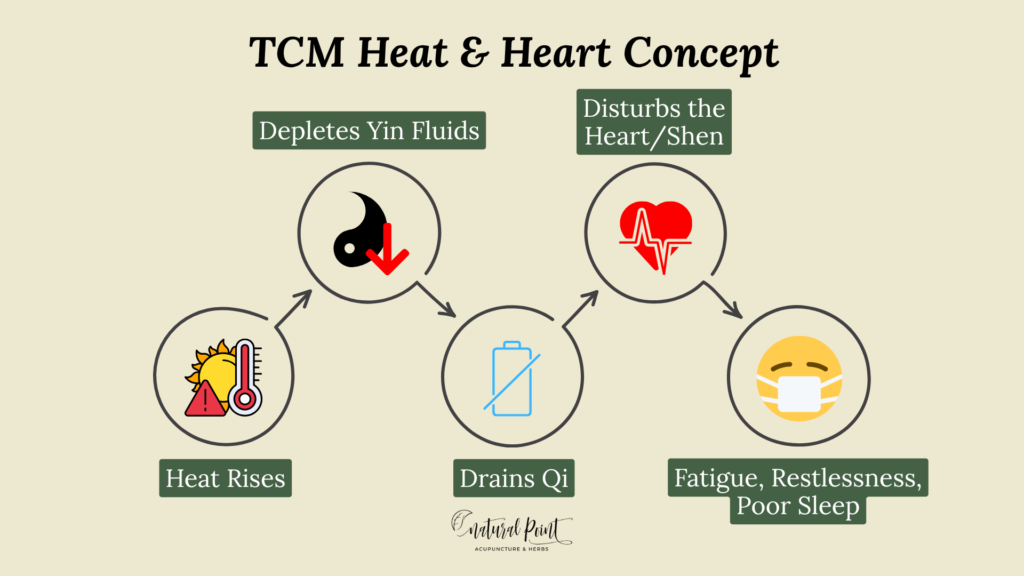
In Traditional Chinese Medicine, each season has an organ system it’s most closely associated with, and summer belongs to the Heart. Not just the physical, pumping-blood heart — in TCM, the Heart also houses the Shen, or spirit, and governs mental clarity, calm, and how well you sleep.
Summer heat is considered one of the six external pathogenic factors, and it behaves exactly the way you’d expect fire to behave: it rises, it consumes, and it depletes. When excessive heat builds up in the body, it can disturb the Heart and scatter the Shen, which shows up as restlessness, poor concentration, irritability, and a wired-but-tired feeling that no amount of coffee seems to fix.
At the same time, heat forces the body to sweat more to try to cool itself down. In TCM terms, sweat is considered a byproduct of Yin fluids — the cooling, moistening, nourishing substances in the body. Excessive sweating doesn’t just cause dehydration in the Western sense; it depletes Yin and Qi (your body’s functional energy) together. This is why summer fatigue often feels different from being “tired.” It feels like being hollowed out.
This is also the underlying pattern behind summer insomnia and 3 am wake-ups that so many of my patients describe this time of year — when Heart Yin runs low, the Shen has nothing to anchor to at night.
Why Rest Doesn’t Fix It (and Houston Makes It Worse)
Here’s the part that confuses most people: they rest, and they still feel exhausted. That’s because summer fatigue in TCM isn’t primarily about a lack of sleep — it’s about depleted fluids and scattered energy. You can sleep eight hours and still wake up feeling wrung out if your Yin and Qi are running on empty.
Houston adds its own layer to this. Our humidity means sweat doesn’t evaporate efficiently, so your body works even harder to regulate its temperature — and loses even more fluid in the process. Then most of us spend our days swinging between two extremes: blistering heat outside and over-air-conditioned spaces inside. That constant temperature whiplash is genuinely taxing on the nervous system, on top of everything the heat itself is already doing.
It’s also worth knowing the more clinical warning signs of heat-related depletion, since Houston summers can push things past ordinary fatigue into something that needs immediate attention. The CDC notes that heat exhaustion — driven by excessive fluid and salt loss — commonly shows up as heavy sweating, dizziness, headache, and nausea, and can progress if the body isn’t cooled down and rehydrated. If you or someone around you develops confusion, a very high body temperature, or stops sweating altogether in extreme heat, that’s a medical emergency, not a “push through it” moment. You can read the full breakdown of warning signs on the CDC’s heat and health page.
Most day-to-day summer fatigue doesn’t reach that level, but it exists on the same spectrum — your body is telling you it’s working overtime to keep you cool, and something has to give.
Common Signs of Summer Qi and Fluid Depletion
In my practice, this pattern tends to show up as some combination of the following:
- Fatigue that’s worse in the afternoon, even after a full night’s sleep
- Feeling “wired but tired” — mentally overstimulated but physically drained
- Excessive sweating, even in air conditioning
- Increased thirst that plain water doesn’t seem to satisfy
- Irritability or a short fuse, especially by early evening
- Heart palpitations or a racing feeling, particularly after being outside
- Restless sleep or waking up around 2–3 am
- Low motivation, even for things you normally enjoy
If several of these sound like your summer, your body isn’t broken — it’s responding exactly the way TCM would predict to a season of rising heat and fluid loss. The good news is that this pattern is very treatable, and it’s one of the more satisfying things I get to work on each year because the shift in patients is often noticeable within a couple of weeks.
Why “Cooling Down” the Western Way Can Backfire
Most people’s instinct when they feel overheated and drained is to reach for ice water, iced coffee, and something cold and sweet. I get it — and I’m not going to tell you to never enjoy a popsicle in July. But from a TCM perspective, some of our go-to summer habits actually work against us.
Very cold foods and drinks — think ice water straight from the freezer, or a pint of ice cream — can shock the digestive system and, over time, contribute to internal dampness, which is its own can of worms I’ve written about in detail when it comes to Houston’s humidity and how it affects digestion, energy, and brain fog. Rich, heavy, or overly sweet foods behave similarly — even though ice cream feels cooling in the moment, TCM classifies it as an internally warming, damp-forming food once your body has to digest it.
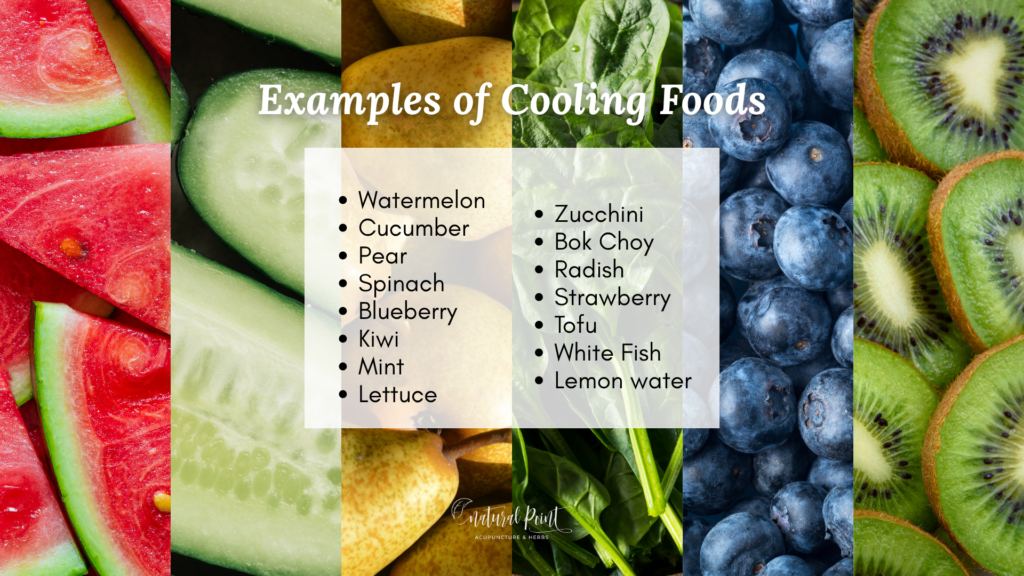
The better approach is to genuinely cool the body without overwhelming digestion: naturally cooling foods like watermelon, cucumber, mint, and leafy greens; room-temperature or lukewarm fluids instead of ice-cold ones; and giving yourself real breaks from the heat rather than white-knuckling through outdoor errands at 2 pm because that’s when you happened to have time.
The Herbal Pivot: Cooling, Qi-Restoring Formulas
This is where herbal medicine genuinely shines, and it’s a big part of why I’ve shifted my practice to lead with Chinese herbal medicine rather than treat it as an add-on to acupuncture.
Acupuncture is wonderful for calming the Shen in a single session and can absolutely help with that wired, overstimulated feeling. But summer fatigue is a depletion pattern — your body is short on fluids and functional energy — and depletion patterns respond especially well to herbal formulas because herbs can nourish the body continuously between visits, not just during a 30-minute session on the table.
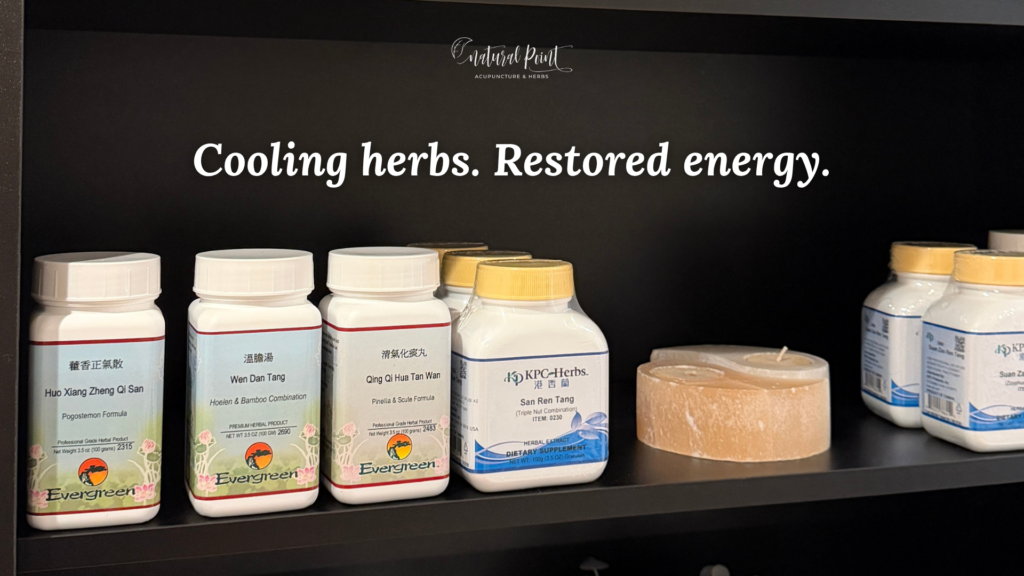
Custom formulas for summer fatigue are typically built around two goals working together: clearing residual heat and restoring the Yin and Qi that heat has burned through. Depending on your specific pattern, that might include cooling herbs to calm Heart fire and irritability, alongside Qi and Yin tonics to rebuild the deep energy reserves the heat has been drawing down. This is very different from grabbing a generic “energy” supplement off a shelf — a formula built for your constitution addresses the actual mechanism of your fatigue instead of just masking it with stimulants.
I also love pointing patients toward everyday ingredients they can lean on between formula refills. I’ve put together a full list of common kitchen herbs and foods that support the body through the seasons if you want a head start before your first visit.
How Acupuncture Still Fits In
None of this means acupuncture takes a back seat entirely — it’s a genuinely valuable partner to herbal treatment for summer fatigue. Specific points along the Heart and Pericardium meridians help settle a racing, overstimulated feeling in the moment, and treatments are deeply relaxing in a season when most of us are running on overdrive. Many of my summer patients tell me their acupuncture appointment is the only 30 minutes all week their nervous system fully powers down. If stress is compounding your summer exhaustion, it’s worth pairing this with a few of the quick TCM stress-relief techniques I share with patients for the moments between visits.
A Quick Story from the Treatment Room
A few summers ago, I had a patient — a teacher enjoying her first “restful” summer off in years — come in convinced something was medically wrong with her. She was sleeping in, doing far less than during the school year, and still felt more exhausted than she had all spring. Her bloodwork had come back normal. She just felt “off.”
Her pulse and tongue told a classic summer-heat story: depleted, wiry, a little restless. We started with acupuncture to calm her Shen and take the edge off the wired feeling, alongside a custom herbal formula to rebuild her Qi and Yin. Within about two weeks, she told me it was the first summer in years she’d actually felt like herself by August instead of just surviving until fall. That shift — from surviving summer to actually enjoying it — is what I want for every one of my patients here in Houston.
FAQ: Summer Fatigue and TCM
Is summer fatigue the same as heat exhaustion?
Not exactly. Heat exhaustion is a medical condition caused by significant fluid and salt loss that requires prompt cooling and hydration. Summer Qi and fluid depletion, in the TCM sense, is a milder, more chronic pattern of tiredness related to how heat affects the Heart and body fluids over the course of the season. If you experience dizziness, confusion, or a very high body temperature, that’s a signal to seek medical care right away, not just a herbal formula.
Why do I feel more tired in Houston summers than I did living somewhere drier?
Humidity slows sweat evaporation, which makes your body work harder to regulate its temperature and lose more fluid overall. Combine that with constant swings between outdoor heat and indoor air conditioning, and Houston summers create a uniquely draining combination compared to a hot, dry climate.
Will drinking more water fix this on its own?
Water helps, but TCM would say fatigue caused by heat is about more than plain hydration — it’s about replenishing Qi and Yin together. That’s why patients who are already drinking plenty of water can still feel drained; the formulas and treatment approach are built to restore energy, not just fluid volume.
Ready to Actually Enjoy Your Summer Again?
If you’ve been white-knuckling your way through another Houston summer, feeling exhausted no matter how much you rest, I’d love to help you figure out what’s actually going on and build a plan around it — most often centered on a custom herbal formula, supported by acupuncture.
Book a free 15-minute consultation here and let’s talk about what your body needs this season.
Or if you’re ready to get started, book your appointment at Natural Point Acupuncture.
And in the meantime, grab my free guide on 5-minute acupressure points for instant relief that you can use at home to help calm that overstimulated, wired-but-tired feeling.